
The 2-Week Reset Challenge

FREE GUIDE: 2-WEEK RESET
Download the free 2-Week Reset Guide, inspired by podcast highlights, with actionable nutrition, lifestyle, and gut health tips you can start today.
What to expect:
14-Day Nutrition Plan
Recipe Book
Gut Health Hacks
Nutrition Tips
Fitness Routines
Community
What Is a Continuous Glucose Monitor (CGM)? Benefits, Accuracy, and Who Should Use One
What Is a Continuous Glucose Monitor (CGM)?
Written by Kerri Rachelle, PhD c., RDN, CSSD, FMP-AC
Quick Answer
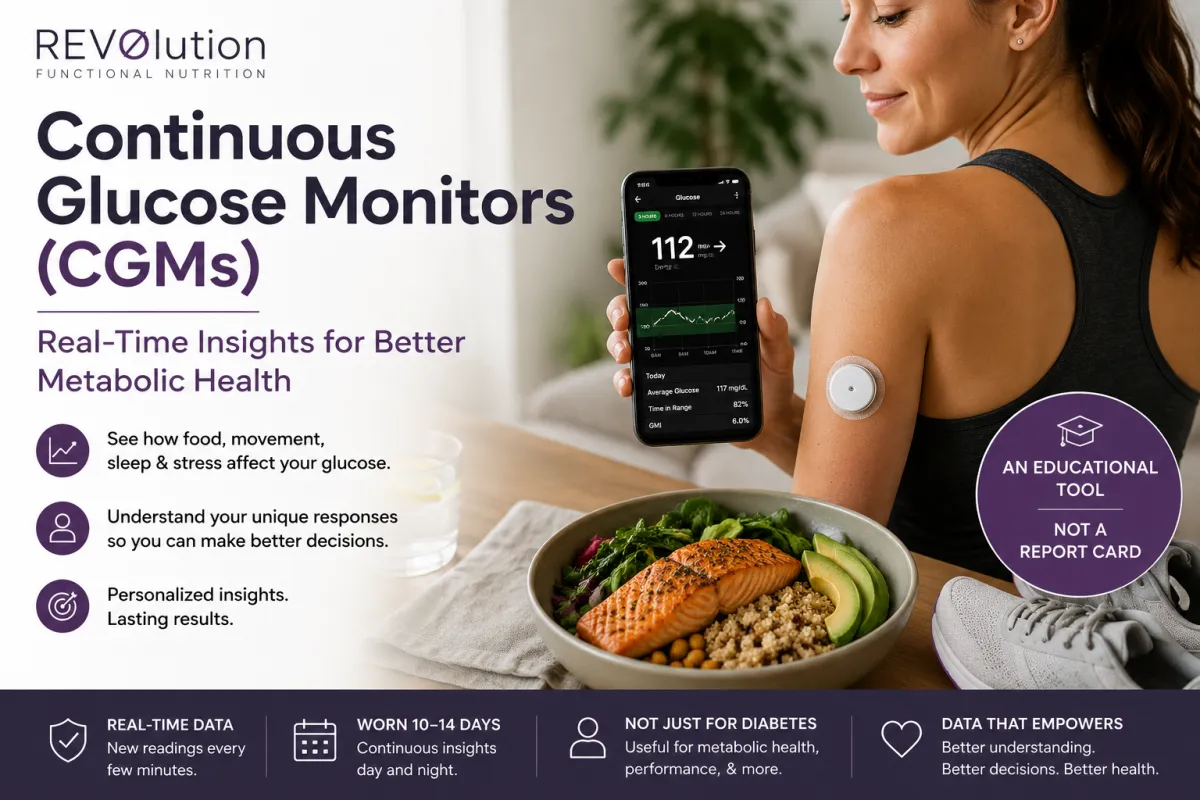
A Continuous Glucose Monitor (CGM) is a small wearable sensor that measures glucose levels throughout the day and night. It allows you to see how your body responds to food, exercise, sleep, stress, illness, and daily habits in real time. While CGMs are commonly used by people with diabetes, they're also becoming valuable tools for understanding metabolic health, insulin resistance, and personalized nutrition.
Key Takeaways
A CGM measures glucose 24 hours a day.
It shows trends rather than relying on a single blood test.
Everyone responds differently to the same foods.
Sleep, stress, movement, and meal composition all influence glucose.
We use CGMs to guide decisions—not judge them.
How Does a Continuous Glucose Monitor Work?
A Continuous Glucose Monitor (CGM) is a small wearable sensor, typically about the size of two stacked quarters, that's applied to the back of your upper arm using a quick, nearly painless applicator. Once in place, it continuously measures glucose levels in the interstitial fluid—the fluid that surrounds your body's cells. While this isn't the same as measuring glucose directly from your bloodstream, interstitial glucose closely reflects blood glucose and provides an excellent picture of how your glucose changes throughout the day.
The sensor sends a new glucose reading to a smartphone app every few minutes, allowing you to see how your body responds to meals, snacks, exercise, stress, sleep, illness, and even a busy day at work. Instead of relying on a single blood sugar measurement taken during your annual physical, a CGM provides hundreds of readings each day, revealing patterns that would otherwise go unnoticed.
Most CGMs are worn continuously for 10 to 14 days, depending on the device. During that time, they allow you and your Registered Dietitian Nutritionist to identify trends, recognize which habits support steadier glucose levels, and make personalized recommendations that fit your lifestyle.
At REV0lution, we don't use CGMs to judge individual meals or chase "perfect" glucose numbers. We use them to better understand your unique metabolism so we can make informed, evidence-based decisions that support your long-term health.
What Can a Continuous Glucose Monitor Teach You?
One of the things we love most about Continuous Glucose Monitors is that they take the guesswork out of nutrition.
For years, you've probably heard advice like, "Eat more protein," "Take a walk after meals," or "Get more sleep." Those are excellent recommendations—but a CGM allows you to see why they matter and how your own body responds.
Instead of wondering whether a particular meal works well for you, you can often see the answer in real time.
For example, you may discover that:
A 10-minute walk after dinner helps keep your glucose levels steadier.
One night of poor sleep leads to higher glucose levels the following morning.
A stressful meeting raises your glucose even if you haven't eaten.
Eating protein and fiber before carbohydrates results in a gentler glucose response than eating carbohydrates first.
Two people can eat the exact same meal and have completely different glucose responses.
That's one of the most important lessons a CGM teaches us: nutrition is personal.
There is no single meal plan or diet that works perfectly for everyone. Your genetics, muscle mass, sleep, stress, physical activity, gut health, hormones, medications, and even the time of day can influence how your body responds to food.
A CGM also helps identify patterns you may never have noticed otherwise. You might find that skipping breakfast leaves you reaching for sugary snacks later in the day, or that eating a balanced lunch gives you more stable energy throughout the afternoon. Some people discover that their morning coffee has little effect on glucose, while others notice a measurable increase, especially when combined with poor sleep or high stress.
At REV0lution, we view CGMs as educational tools—not report cards. Our goal isn't to create perfectly flat glucose lines or make you afraid of eating carbohydrates. Instead, we use CGM data to understand your unique physiology and make personalized recommendations that support better energy, metabolic health, and long-term well-being.
The more you understand how your body responds, the more confident you become in making decisions that fit your life—not someone else's.
Do You Need Diabetes to Wear a CGM?
Absolutely not.
Although Continuous Glucose Monitors were originally developed to help people manage diabetes, they're increasingly being used by healthcare professionals as educational tools to better understand metabolic health. In fact, many people who wear a CGM have never been diagnosed with diabetes.
A CGM may be helpful if you're working to better understand or improve:
Prediabetes
Insulin resistance
Metabolic syndrome
Weight management
Athletic performance and recovery
Energy fluctuations throughout the day
Personalized nutrition and food choices
Because CGMs provide real-time feedback, they can help explain why you feel energized after one meal but sluggish after another, or why your blood sugar may be affected by stress, sleep, illness, or exercise.
It's important to remember that a CGM does not diagnose disease. Rather, it provides valuable information about how your body responds to the choices you make each day. When interpreted alongside your symptoms, laboratory testing, medical history, body composition, and health goals, CGM data can help create a more personalized and effective plan for improving your metabolic health.
At REV0lution, we don't recommend CGMs for everyone. We recommend them when they can answer a meaningful clinical question, educate you about your own metabolism, or provide insights that help move your health forward.
What Can’t a CGM Tell You?
A Continuous Glucose Monitor is powerful, but it is still only one piece of the puzzle.
A CGM can show how your glucose responds throughout the day, but it does not explain everything about your metabolic health. It does not replace fasting insulin, hemoglobin A1c, lipid testing, inflammation markers, a comprehensive nutrition assessment, your symptoms, or your health history.
This matters because glucose is only one signal. Someone may have fairly stable glucose but still have elevated fasting insulin, abnormal lipids, inflammation, poor sleep, low muscle mass, or symptoms that need a deeper look.
At REV0lution, we never make recommendations from a single number. We combine laboratory testing, lifestyle factors, symptoms, body composition, wearable data when available, and your personal goals to build a plan that is tailored to you. A CGM helps us see patterns, but your full story helps us understand what those patterns mean.
Should You Worry About Every Glucose Spike?
No.
One of the biggest misconceptions about CGMs is that every increase in glucose is “bad.” Your blood sugar is supposed to rise after eating. That is a normal part of digestion and metabolism.
The goal is not to create a perfectly flat glucose line. The goal is to understand patterns. How does your body respond to different meals? What happens when you sleep poorly? Does walking after dinner help? Do certain meals leave you energized while others lead to cravings or fatigue?
At REV0lution, we use CGMs as educational tools—not report cards. The goal is not fear, restriction, or chasing perfect numbers. The goal is to use real-time feedback to make sustainable choices that support your long-term metabolic health.
Bottom Line
A Continuous Glucose Monitor gives you something many people have never had before: real-time feedback.
Instead of wondering how your body responds to a meal, a workout, a stressful day, or a poor night's sleep, you can actually see it. That information allows you and your Registered Dietitian Nutritionist to make more personalized decisions that support your metabolism, energy, and long-term health.
Suggested Reading
Fasting Insulin: The Metabolic Marker Most People Have Never Checked
Functional Medicine Lab Testing: What It Is, What It Isn't, and When It's Helpful
FAQ
Do you need to have diabetes to wear a Continuous Glucose Monitor?
No. While CGMs were originally developed for diabetes management, they are increasingly used by people with prediabetes, insulin resistance, metabolic syndrome, athletes, and individuals who want to better understand how nutrition and lifestyle affect their metabolism.
How accurate are Continuous Glucose Monitors?
Modern CGMs are generally very accurate, but they measure glucose in the fluid surrounding your cells rather than directly in your bloodstream. Because of this, readings may lag behind finger-stick glucose measurements by several minutes, particularly during rapid changes in blood sugar.
Can a CGM help with weight loss?
A CGM doesn't cause weight loss by itself. Instead, it provides real-time feedback that can help you understand how different foods, meal timing, sleep, stress, and exercise affect your body. Many people find that this personalized information makes it easier to build healthier habits.
What foods cause the biggest glucose spikes?
The answer varies from person to person. Refined carbohydrates, sugar-sweetened beverages, and highly processed foods commonly raise glucose quickly, but sleep, stress, physical activity, muscle mass, and meal composition also influence your response. A CGM helps identify your unique patterns.
Should I avoid every glucose spike?
No. Blood sugar naturally rises after eating. The goal isn't to create a perfectly flat glucose line—it's to understand trends and make sustainable choices that support long-term metabolic health.
How long do you wear a CGM?
Most CGMs are worn continuously for approximately 10 to 14 days, depending on the device. During that time, they provide hundreds of glucose readings each day.
Are CGMs covered by insurance?
Insurance coverage depends on your diagnosis and health plan. Some individuals qualify through their medical insurance, while others choose to purchase CGMs privately for wellness or metabolic health purposes.
Does REV0lution use Continuous Glucose Monitors?
Yes. When appropriate, our Registered Dietitian Nutritionists may recommend CGMs as part of a comprehensive assessment of metabolic health. We combine CGM data with laboratory testing, symptoms, body composition, wearable data, nutrition assessment, and your health goals to provide personalized recommendations.
References
Battelino T, et al. Clinical Targets for Continuous Glucose Monitoring Data Interpretation: Recommendations From the International Consensus on Time in Range. Diabetes Care. 2019.
Dixit AA, et al. Use of Continuous Glucose Monitoring in Individuals Without Diabetes: A Systematic Review. Journal of Clinical Endocrinology & Metabolism. 2024.
American Diabetes Association. Standards of Care in Diabetes—Continuous Glucose Monitoring. Diabetes Care. Updated annually.
Vigersky RA, McMahon C. The Relationship of Hemoglobin A1C to Time-in-Range in Patients With Diabetes. Diabetes Technology & Therapeutics. 2019.
Heinemann L. Continuous Glucose Monitoring and Continuous Glucose Monitoring Systems. Journal of Diabetes Science and Technology. 2018.